
Reno County Inmate Release Meaning
A Reno County inmate release is a custody event. It is not just a name vanishing from a screen. The Reno County Correctional Facility may release someone on bond, after time served, or under a court order. It may also turn that person over to the Kansas Department of Corrections, another county, the U.S. Marshals Service, or immigration authorities. Only the first group necessarily leaves custody for the community. The release type and destination make the difference.
The Reno County Sheriff’s Office holds the local booking and release record. The Reno County District Court may hold the order that explains the event. Kansas VINE can report a county-jail custody change. KASPER, the Kansas Adult Supervised Population Electronic Repository, covers people sentenced to KDOC custody. These sources should not be treated as substitutes for one another. A person released from Hutchinson Correctional Facility belongs in KASPER, while a short Reno County jail stay may never appear there.
- Time served
- The jail part of a sentence has been completed.
- Parole
- Release from prison under supervision for an eligible indeterminate sentence.
- Postrelease supervision
- The supervised part that follows prison in many determinate Kansas sentences.
- Discharge
- The sentence obligation and KDOC supervision have ended.
Note: A missing jail result shows only that the person is not displayed there, not that all custody has ended.
Reno County Release Types
Release language should be read as written. “Released” can describe a community departure, but a custody log may use the same broad event category when one agency hands a person to another. Court entries add context, yet even a dismissal in one case does not rule out an unrelated hold. The following distinctions keep a Reno County released inmate search tied to the actual event.
| Release type | What it means | Best next source |
|---|---|---|
| Bond or recognizance | The person returns to the community while the case continues. | Jail release record and court docket |
| Time served | The ordered jail portion has ended. | Release sheet and sentencing entry |
| Dismissal or acquittal | The local case no longer supports custody, subject to other holds. | Court order plus jail event |
| Probation | The court permits community supervision instead of continued confinement. | Court docket and local supervision office |
| Parole or postrelease | A state prisoner leaves confinement but remains under KDOC supervision. | KASPER and the parole office |
| Transfer or detainer | Another institution or agency receives custody. | Destination field and receiving agency |
A death or escape can also remove or change a current listing, and neither is a release to the community. When the exact meaning matters, ask for the recorded reason and receiving agency instead of relying on a blank roster result.
Reno County Release Record Fields
The strongest county proof is an existing booking/release sheet, custody-event log, or jail-management entry tied to one booking. A narrow request should name the person, date range, and booking or case number when known. It should also seek the destination field. That field can resolve whether “released by Reno County” meant going home or entering a different form of custody.
| Field | What it shows |
|---|---|
| Name and aliases | The identity recorded for the booking |
| Booking number | The link to a specific jail stay |
| Booking date and time | When local custody began |
| Charges and agency | Why the person entered custody and who originated the matter |
| Court case number | The tie to the legal proceeding |
| Release date and time | When Reno County custody ended |
| Release reason or type | Bond, order, time served, transfer, or another event |
| Destination or recipient | Community departure or the agency that took custody |
KDOC records have a different field set. KASPER may show KDOC number, convictions, controlling sentence, sentence dates, movements, current location, anticipated release date, parole office, supervision type, and discharge status. A movement is not a community release. A parole or postrelease status means the person is outside prison but still serving the sentence. “Discharged” is the clearer state marker that the KDOC obligation ended.
Request Reno County Release Records
Use the county Records page and the formal Request for County Records. Ask for an existing record, not a new report or analysis. If the online form requires an account or does not work, route a written Kansas Open Records Act request to the records custodian. The sheriff’s main office can identify where correctional-facility records are kept.
- Identify the person by full name and include the booking or court case number if known.
- Give approximate booking and release or transfer dates. Ask for the existing booking/release sheet and custody-event entry.
- List the needed fields, especially release date and time, event type, and destination or receiving agency.
- Ask for electronic delivery and a cost estimate before fees exceed a limit you set.
- If anything is withheld, request the statutory basis in writing.
Under K.S.A. 45-218, an agency must act as soon as possible and no later than the end of the third business day. Action can mean production, denial, a request for clarification, or a detailed explanation of delay. It is not a promise that every record arrives within three days. Charges may reflect reasonable actual search, review, redaction, and copy costs. No verified Reno County fee schedule for this record was found, so request an estimate.
The official county records channel shows the local starting point for a historical release request.
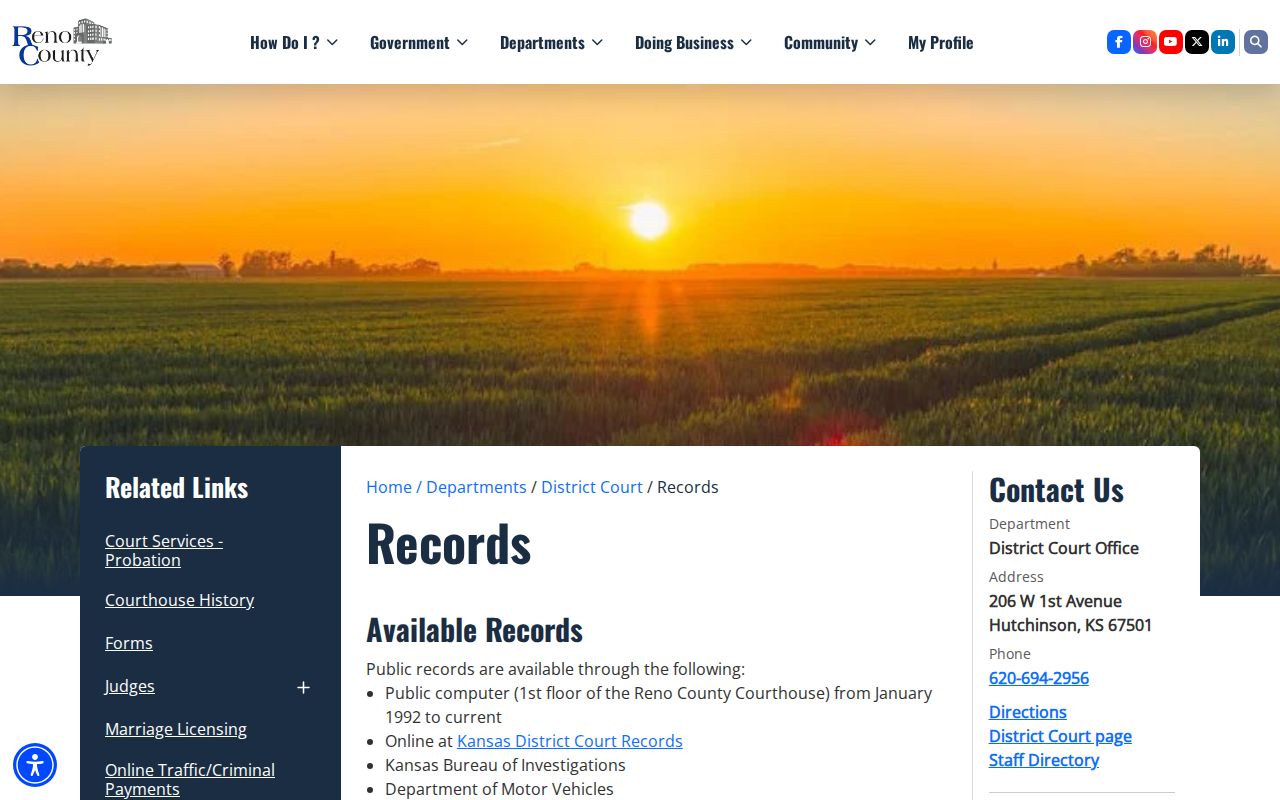
A focused request is easier to route than a demand for a custom release history or broad database export.
Correct Reno County Release Records
Reno County has a two-custodian correction path. An error in a county booking or release record belongs with the Reno County Sheriff’s Office or county records custodian. An error in the KASPER public record belongs with KDOC at kdoc_pub@ks.gov. The split follows ownership of the data. Asking KDOC to change a county-jail event, or asking the sheriff to alter a state sentence record, will send the issue to the wrong office.
First save the exact field, source, and date observed. Then supply the correct booking number, KDOC number, case number, or other matching identifier. A court order may support a correction, but the originating custodian controls its own record. For KASPER timing questions, remember that KDOC says the system updates each working day. A new release or discharge may not appear at once.
Note: Record corrections should identify the source and field precisely because the county jail, court, and KDOC maintain separate systems.
Reno County Release Court Records
Reno County is part of the 27th Judicial District. Its criminal docket is the durable legal companion to a jail event. Search the Kansas court public portal by name or case number, then review entries near the custody-change date. A bond order, dismissal, probation sentence, commitment to KDOC, revocation, or time-served ruling can explain why the jail acted.
The docket and custody record answer different questions. The court order supplies legal authority. Kansas VINE or the jail event shows the physical change and may reveal a transfer. A judge can dismiss one case while a different warrant keeps the person held. Likewise, a commitment entry may explain why a Reno County jail result disappeared and a KASPER record later appeared. Pair both sources when release reason and actual destination matter.
Can a court order alone prove release? No. It may authorize release, but processing and unrelated holds can affect the physical event. Confirm the recorded jail departure or transfer.
Reno County Release and Expungement
A live roster, a historical jail record, and a court record do not share one retention rule. Reno County publishes no discovered online retention period for a release listing. Ask the county custodian whether the booking/release record remains in the jail system or an archive. Sealed or expunged matters may be withheld under governing law, while KDOC says covered KASPER names generally remain unless a conviction is overturned, expunged, or changed by executive clemency.
Kansas expungement timing makes the discharge field important. Under K.S.A. 21-6614, the waiting period commonly starts after sentence satisfaction or discharge from probation, community corrections, parole, postrelease supervision, conditional release, or a suspended sentence. It does not necessarily start when the person first walked out of jail or prison. Arrest expungement and municipal cases use different statutes.
Search Reno County Released Inmates
Start with the last known custodian. That choice controls the full search path. Kansas VINE is for a named person in a participating county jail. KASPER is for a Kansas state sentence. The BOP locator covers many federal prisoners, while ICE has its own short-window locator. The Reno County court docket explains the local legal event, and a records request supplies historical proof when no public feed exists.
- Confirm whether the person was last held by Reno County, KDOC, federal authorities, or ICE.
- For the county jail, search Kansas VINELink and verify identity, facility, and status. Call 620-694-2741 if release versus transfer matters.
- Check the Reno County court case for bond, dismissal, sentence, probation, commitment, or another order.
- For a state sentence, search KASPER by KDOC number when possible and read movements, location, supervision, and discharge together.
- Use BOP, USMS, or ICE sources for the matching federal custody path.
- Request the booking/release sheet or agency record when online sources do not settle the question.
The county has no discovered official recent-release archive. The Reno County 24-Hour Release List explains how to request a narrow same-day range. For one person, identity details and an exact booking period are more useful than a broad list request.
KDOC Search for Reno Releases
For Hutchinson Correctional Facility or another Kansas prison, use the KASPER offender search. It covers people sentenced to the Kansas Secretary of Corrections since 1980 who are incarcerated, under post-incarceration supervision, or discharged. It is not a Reno County jail archive. Accept the disclaimer, search by KDOC number if known, and confirm a name match from several fields.
| Search field | Use | Key caution |
|---|---|---|
| KDOC number | Most direct identifier | Confirm it belongs to the right person |
| Last, first, middle name | Basic name search | Review aliases and identity details |
| Date of birth or age | Narrow an advanced search | Do not rely on name alone |
| Conviction county | Distinguish similar records | It is not the same as release residence |
| Location | Check current institution or office | A movement may be a transfer |
| Supervision type | Find parole, inmate, absconder, or discharged status | Parole is not discharge |
Open the detail record. Read current status, movement history, parole office, sentence dates, and the live anticipated-release label together. A forecast does not prove that release occurred. A past movement from Hutchinson Correctional Facility followed by parole or postrelease status supports departure to supervision. “Discharged” more directly signals the end of KDOC obligations.
The official KASPER entry illustrates the disclaimer and search controls used for a Kansas state release lookup.
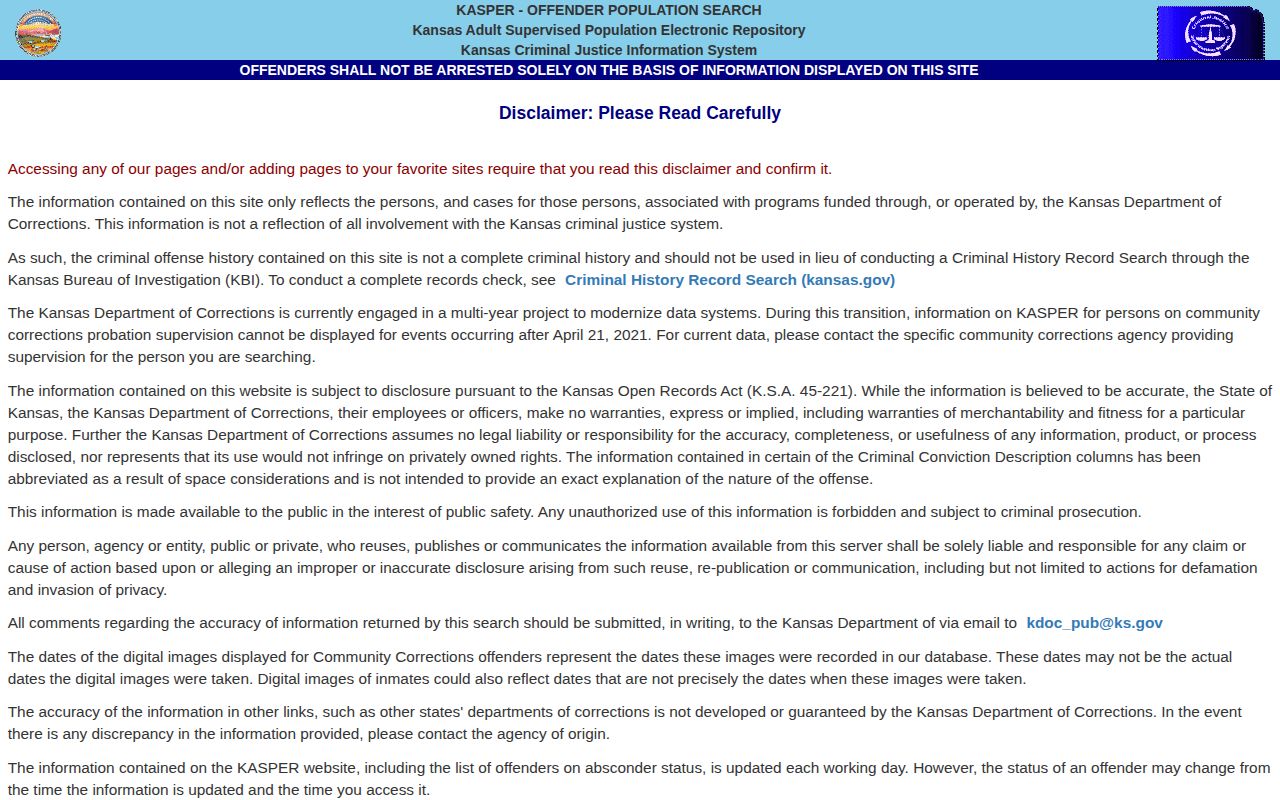
KDOC updates KASPER each working day, so a very recent state release may require direct records confirmation.
Reno County Recent Release Records
The official Reno County Inmate Information page is a contact and instruction source. The research sweep found no distinct official 24-hour list, 72-hour list, or recent-release archive. It also found no official sheriff app with a release feed. That absence should not be filled with a current roster. Instead, use VINE for one named county-jail person, call the facility, and seek the existing record for the needed date range.
The official inmate-information channel shows the jail contact route rather than a public historical release window.
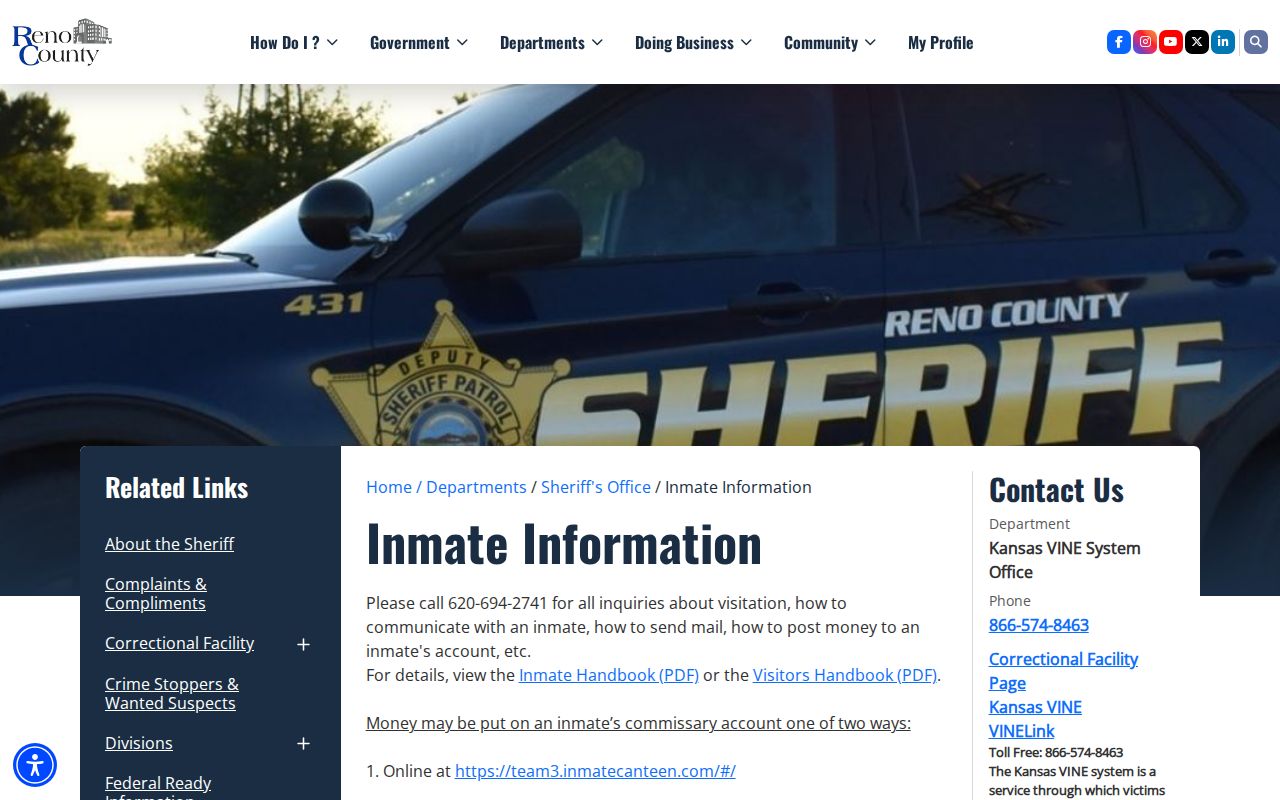
For a time window, ask whether an existing release log is maintained and request it in its existing electronic form. KORA does not require the county to build a new custom list.
Reno County Release Supervision Split
Reno County has two local supervision routes that cover different people. The Hutchinson Parole Office handles KDOC parole and postrelease cases for Reno and Rice Counties. Reno County Community Corrections, at 206 W. 1st Avenue in Hutchinson and 620-694-2934, handles qualifying felony probation and community-corrections cases. Court probation and federal supervised release follow still other systems.
The local distinction is vital because KASPER warns that community-corrections probation events after April 21, 2021 cannot be displayed due to system modernization. A blank KASPER result for that local probation information does not settle supervision status. Check the Reno County Community Corrections office and the court docket. For KDOC supervision, read the live KASPER parole-office field.
Note: Probation comes from a court sentence, while parole and postrelease supervision follow Kansas prison custody under KDOC.
Reno County Release Notifications
Kansas VINELink provides custody searches and notifications for county-jail records. Search by first and last name or an available identifier. Compare the facility and identity before relying on the status. A release notice should trigger verification because VINE can report transfer or another custody change, and Kansas VINE does not include KDOC offenders housed in state prisons.
Registration can use telephone or email. Telephone alerts use a memorable four-digit PIN, followed by the pound key when the call arrives, to acknowledge the notice and stop repeat calls. The live portal lists 1-866-574-8463. For a person at Hutchinson Correctional Facility, use KASPER rather than VINE.
Reno County ICE Release Window
A Reno County jail transfer to ICE is not a community release. Ask the county booking/release record for the receiving agency, then use the ICE Online Detainee Locator System. ODLS covers people now detained and those released from ICE custody within the last 60 days. Search by A-number and country of birth or by the required biographical fields.
The 60-day period makes ODLS a short-window check, not a permanent archive. After that period, no result proves little. Use ICE contact or an authorized FOIA or Privacy Act request. The BOP locator is different. It may show a past federal prison release date, but it does not rule out supervised release, state custody, USMS custody, or ICE custody.
Does “released by Reno County” mean free? Not always. The county may have relinquished control to federal or immigration authorities. The destination field resolves that ambiguity.
Reno Release Status Sources
Choose the source by custodian and question. Current-custody tools show where someone is held now. Release records document a past event. Court records explain legal authority, while supervision records show what continues after physical confinement ends.
| Source | Best for | Does not prove |
|---|---|---|
| Reno jail information | Current local custody and direct release or transfer confirmation | A complete historical release archive |
| County booking/release record | Local release date, type, and destination | End of every other agency hold |
| Kansas VINE | Named county-jail custody change and notification | KDOC prison release |
| KASPER | State prison movement, supervision, and discharge | A short county-jail booking |
| Reno court docket | Bond, dismissal, sentence, probation, or commitment order | The exact jail-door event |
| BOP or ICE locator | The matching federal custody system | Freedom from all other custody or supervision |
Reno County Release Facilities
Two adult correctional facilities are materially relevant in Reno County, but they serve different systems. The Reno County Correctional Facility is the sheriff-operated county jail. A community release can be checked through VINE, the jail, the booking/release record, and the district-court case. Its destination field can instead show transfer to KDOC, another county, USMS, or ICE.
Hutchinson Correctional Facility is a KDOC state prison. Its release path is KASPER and KDOC records, not the Reno County jail display or Kansas VINE. Parole or postrelease means the person has left prison under supervision. Discharged means the Kansas sentence obligation has ended. A prison movement or work-release placement is not itself community release.