
Reno Parole and Probation Compared
Parole, postrelease supervision, and probation can all follow time in custody, yet they arise in different ways. Parole is a supervised release that the Kansas Prisoner Review Board may approve for an eligible indeterminate sentence. Postrelease supervision follows the prison part of most determinate Kansas guidelines sentences. Probation is ordered by a court, often instead of a prison term or after a short jail term. In Reno County, that difference determines whether to consult KASPER, KDOC parole services, Reno County Community Corrections, or the sentencing court.
| Status | Who orders or controls it | Best verification source |
|---|---|---|
| Parole | Kansas Prisoner Review Board and KDOC | KASPER status, movement, and parole office |
| Postrelease supervision | Kansas law, sentence, and KDOC | KASPER sentence and supervision fields |
| Community corrections probation | Sentencing court and local program | Reno County Community Corrections and court docket |
| Other court probation | District or municipal court | The court case and supervising office |
A person on any of these forms of supervision may live outside a correctional institution while the sentence remains active. By contrast, “Discharged” in KASPER is the clearest public state-record status that the KDOC obligation ended. A release movement and a discharge should not be treated as the same date.
- Parole
- Board-approved release from confinement for an eligible indeterminate sentence, followed by supervision.
- Postrelease supervision
- The supervised part that follows prison for many determinate guidelines sentences.
- Probation
- A court order allowing a person to remain in the community under stated rules.
- Discharge
- The end of the sentence or supervision obligation recorded by the responsible authority.
Verify Reno Post-Release Supervision
Start with the person’s last known custodian. Someone released from Hutchinson Correctional Facility is checked through the KASPER search. A person sentenced to local community corrections may need direct confirmation from Reno County Community Corrections because the state repository has a known gap. Court probation is confirmed from the Reno County criminal docket and the office identified in the sentencing order.
- Identify the case as a county-jail, Kansas prison, or court-probation matter.
- For a KDOC case, search by KDOC number when available. Otherwise use the exact name and compare aliases, birth details, conviction county, and photograph.
- Open the detail record. Read status, supervision type, movements, sentence dates, and the listed parole office together.
- For community corrections, contact the Reno County office and check the sentencing court docket. Do not rely on an empty KASPER history.
- Confirm a recent change with the listed office because KASPER updates each working day, not in real time.
A prison movement followed by “Parole” or “Postrelease” supports release to supervision. It does not prove the sentence ended. The broader Reno County released-inmate search path explains how a jail record, court order, and custody system can be reconciled when the destination is unclear.
Reno Supervision Office Routes
Reno County has two named supervision routes. The Hutchinson Parole Office serves KDOC parole and postrelease cases in Reno and Rice Counties. Reno County Community Corrections handles qualifying local felony supervision. An office listed on a live person record takes priority over a general service-area description because assignments can change.
Hutchinson Parole Office
113 W. 1st StreetHutchinson, KS 67501
Phone: 620-669-0175
KDOC South region service for Reno and Rice Counties
Reno County Community Corrections
206 W. 1st AvenueHutchinson, KS 67501
Phone: 620-694-2934
Official local office page
The local program describes officer contact, testing, referrals, and evidence-based interventions for felony cases. Those broad program duties do not reveal a person’s private conditions. Ask only for the public status or routing needed to confirm supervision.
Reno Supervision Conditions and Violations
Conditions can include reporting, approved residence, treatment, testing, travel limits, or compliance with court and board orders. The exact terms depend on the sentence and supervising authority. A violation may lead to added instructions, a court filing, a warrant, revocation proceedings, or renewed custody. It should not be inferred from a missed appointment, a stale web page, or a person’s absence from a roster.
Kansas publishes official absconder information, but it separates parole absconders from community-corrections absconders. “Absconder” means the authority reports loss of contact or a violation status. It is not the same as a conviction for a new offense, and an entry does not prove that the person has already returned to jail.
The official Kansas parole absconder lookup shows the state route used for this narrow status check.
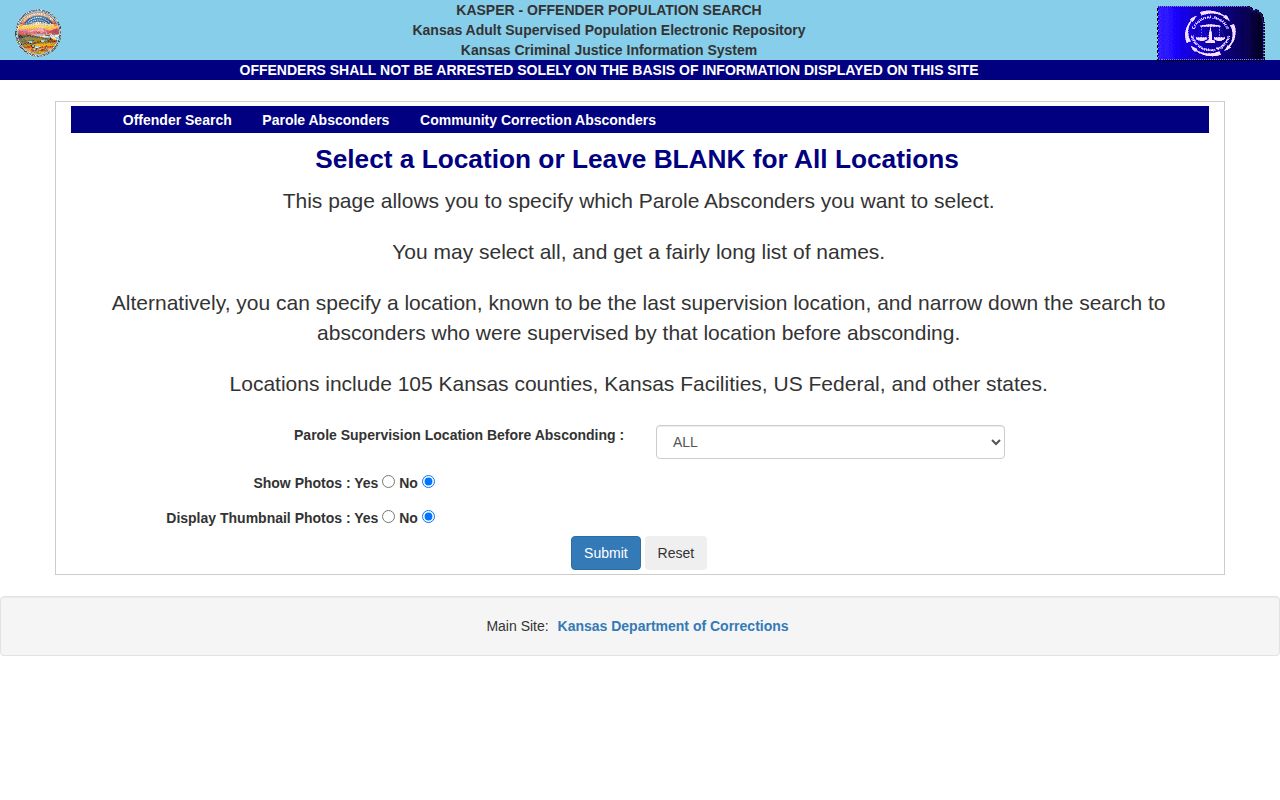
The screen belongs to the KDOC parole system, so local community-corrections cases must be checked through their separate official route.
Information should be given to the listed authority. Do not approach or try to detain the person. Kansas VINE may later report a county-jail custody event, but VINE does not monitor KDOC parole status and is not a supervision register.
Reno Probation’s KASPER Record Gap
KASPER warns that community-corrections probation events after April 21, 2021 cannot be displayed because of system modernization. This limitation is especially important in Reno County because the local Community Corrections office is an active, separate supervision system. A blank state result does not settle whether the person has local probation, has completed it, or has a pending violation.
Use the sentencing case as the durable legal source. The docket may show the probation order, community-corrections placement, later modification, revocation, or discharge. Then contact the local office for current routing. The court record explains the legal order, while the office confirms who administers it.
Note: KASPER is useful for KDOC parole, but local records remain necessary for modern Reno County community-corrections events.
Correct Reno Supervision Records
A suspected error must go to the custodian that owns the record. KDOC provides KASPER locating guidance and directs public-record error reports to kdoc_pub@ks.gov. That is the proper channel for a wrong KDOC status, movement, or sentence field. It cannot amend a sheriff booking sheet or a Reno court entry.
For a county release-record issue, use the Reno County records channel. A court docket error belongs with the court under its own correction process. State the exact field, the displayed value, the reason it appears wrong, and the supporting source. This two-custodian path prevents delay caused by asking one agency to alter another agency’s record.
Keep a copy of the page or record as observed, including its date. KASPER’s working-day updates can make a valid recent change look stale for a short period.
Reno Parole Hearing Records
The Kansas Prisoner Review Board calendar and listed-offender page can identify an upcoming public-comment session. The list may show commitment name, KDOC number, conviction county, case, offense, eligibility month, and potential release month. A Reno entry refers to the county of conviction. It does not prove that the person is held in Reno County or plans to return there.
Board terms have narrow meanings. “PAROLE” is an approval subject to the release plan, conditions, and final administration. “CONTINUE” postpones the decision. “PASS” denies parole for the period set by the board. Even an approval is not the physical release record. A later KASPER movement and supervision status provide stronger confirmation that the person actually left prison.
The board’s listed-offender page can show a potential release month, but that field is not a promise. A release plan may still need review, and a detainer or later conduct can affect the result. No separate public person-level final-decision database was identified. For a specific outcome, compare the hearing information with KASPER after the event and request the public decision record from KDOC or the Prisoner Review Board.
Eligibility itself comes from the sentence and K.S.A. 22-3717. General indeterminate cases use the minimum term less authorized good time, while special murder, off-grid, mandatory, and life-without-parole categories have distinct rules. A calendar entry cannot replace that sentence analysis.
Most post-1993 on-grid determinate sentences follow statutory postrelease rather than an ordinary discretionary parole hearing. Sentence type and offense date therefore matter before reading a hearing calendar as a release forecast.
How Reno Supervision Ends
Supervision ends through the lawful discharge process for the sentence involved. For a KDOC case, KASPER may change from parole or postrelease to “Discharged.” For local probation, the court docket may contain a discharge or satisfaction entry. Sentence expiration, approved early discharge, a final court order, or completion of the required term may supply the legal basis.
Discharge matters beyond the day a person left a facility. Kansas expungement waiting periods under K.S.A. 21-6614 can run from sentence satisfaction or discharge from probation, community corrections, parole, postrelease, conditional release, or a suspended sentence. The release date alone may therefore be the wrong date for that calculation.
A current jail roster cannot confirm discharge because it answers only whether the person is listed in that custody system now. Preserve the final supervision record and the court or KDOC source that issued it.
For a person released from Reno County Correctional Facility, ask whether the case ended in probation, community corrections, transfer to KDOC, or release without supervision. For a person leaving Hutchinson Correctional Facility, read the KASPER supervision type and assigned parole office. These two routes prevent a county-jail disappearance from being mistaken for state parole.
The Reno County inmate-information channel can route a custody question, while the Reno County District Court contact page supports a court-order inquiry. Neither source replaces the supervision office that owns the active status.