
Reno Projected Versus Actual Release
KASPER uses “Anticipated Release Date,” while KDOC records material also refers to an “Anticipated Guidelines Release Date.” Both labels describe a computed future point, not proof that release happened. The actual event appears later in a custody movement, a county booking/release record, or a status such as parole, postrelease, or discharged.
A pretrial Reno County detainee usually lacks a sentence-based release date. Bond may authorize release, but processing and another hold can delay or prevent departure. A person sentenced to county jail may have a court term, yet local jail credit and administration still control the recorded event. A KDOC prisoner has a state computation, but even that calculation can change before release.
The distinction also protects against a common mistake. A transfer from Reno County Correctional Facility to Hutchinson Correctional Facility removes a person from local custody without releasing the person into the community.
Find Reno Projected Release Dates
First identify the custody system. KASPER covers people sentenced to the Kansas Secretary of Corrections since 1980, including current imprisonment, post-incarceration supervision, and discharge. It is not a Reno County jail-release database. County sentences require the court journal entry, jail credit, custody dates, and any computation maintained by the jail.
- Classify the case as pretrial county custody, a county-jail sentence, or a KDOC sentence.
- For KDOC, accept the KASPER disclaimer and search by KDOC number when known. Otherwise compare exact name, aliases, birth details, conviction county, and photograph.
- Open the detail record. Read controlling sentence, sentence-begins date, parole eligibility, conditional release, anticipated date, sentence expiration, movements, and supervision.
- For a Reno County sentence, obtain the sentencing journal entry and jail-credit order from the court, then ask the jail for the current computation or recorded release event.
- Record the date on which the online result was observed. Confirm a near-term event directly because KASPER updates each working day.
The official KASPER search entry is the starting point for a Kansas state-prison projected date.
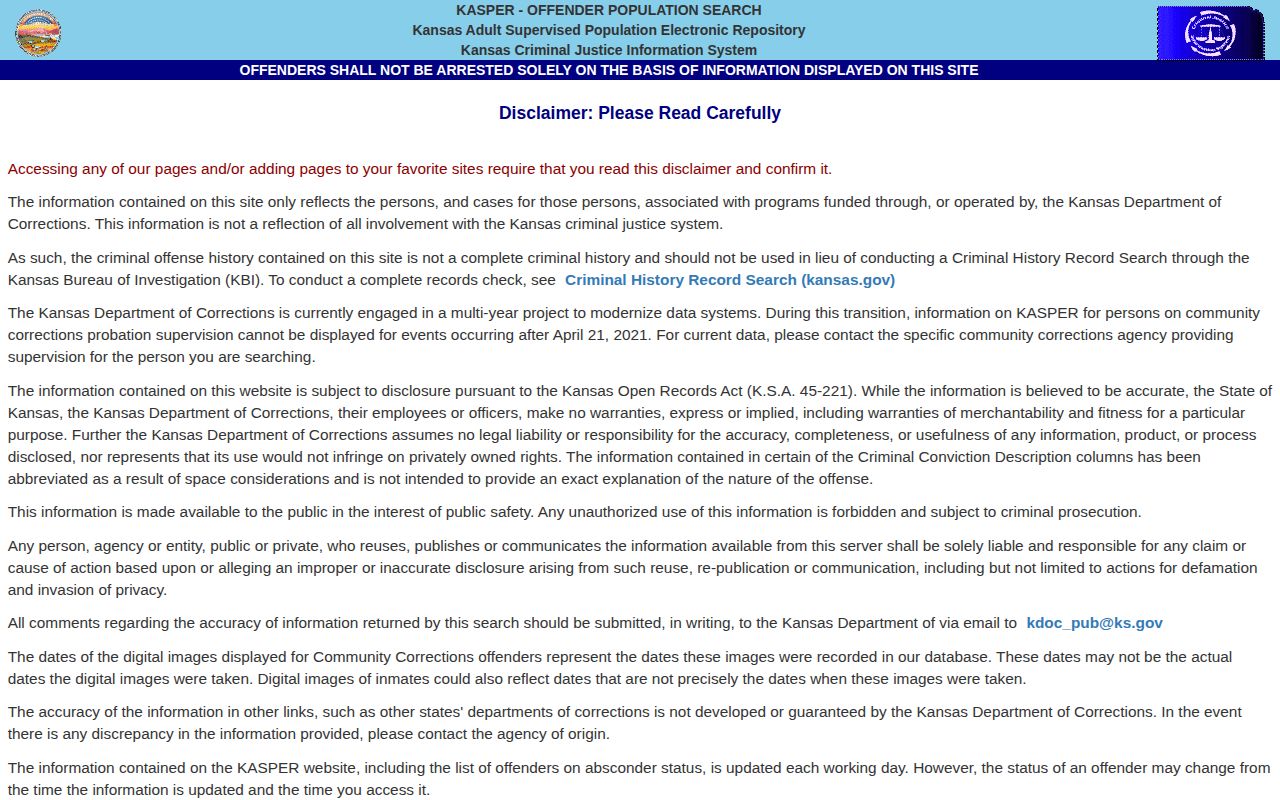
The search must be followed into the matching detail record, where sentence, anticipated-date, movement, and supervision fields can be compared.
A past anticipated date paired with “Inmate” status needs more checking. It can reflect recalculation, credit loss, another sentence, or update timing. A later institutional movement paired with parole or postrelease is much stronger evidence that release from prison occurred. “Discharged” indicates the KDOC sentence obligation ended.
KASPER’s advanced search can narrow by identity details, birth date or age range, conviction county, current location, and supervision type. These filters help separate people with similar names. Still, conviction county and current facility answer different questions. A person at Hutchinson Correctional Facility may have a case from another county, and a Reno County conviction does not prove current placement in Reno County.
Read the sentence fields as a set. “Sentence begins” identifies a computation input, while “sentence expiration” concerns the outer end of the obligation. Parole eligibility applies to the cases governed by that process. Conditional release is a separate statutory point for an indeterminate sentence. The anticipated guidelines date is a forecast based on the information and credit then in the system. Movement history shows what later occurred. When these fields appear to conflict, current status and the newest movement deserve close attention, followed by a question to KDOC sentence computation.
A search result should also be dated when saved. KASPER updates each working day, so a printout made before a weekend or holiday may not reflect a new movement at once. The observed date makes that timing clear and prevents an older forecast from being presented as a current promise.
Kansas Credits Shape Reno Release Dates
K.S.A. 21-6821 governs good-time and program credit for applicable Kansas guidelines sentences. The maximum subtraction is not one fixed rate. Many crimes committed on or after July 1, 1993 use a maximum 15-percent structure, which produced the familiar “serve 85 percent” shorthand. Specified lower-severity nondrug crimes committed on or after January 1, 2008, along with specified drug categories and dates, can use a 20-percent structure.
Current law also permits up to 120 days of program credit for eligible sole sentences and designated successful completions, subject to exclusions. KDOC’s older glossary still describes 60 days. The current statute controls. Credit may be earned, withheld, forfeited, or restored under the rules that apply to the actual case.
Good time does not simply erase the full sentence. In a determinate case, KDOC explains that credit affects how prison and postrelease portions are served. Offense date, severity level, drug or nondrug classification, consecutive terms, jail credit, program eligibility, discipline, court amendments, and statutory exclusions all matter. A person-specific answer must come from KDOC sentence computation, not a generic percentage.
Indeterminate sentences work differently. Parole eligibility can depend on the minimum term less applicable good time, while conditional release is a statutory point calculated against the maximum. Maximum release or sentence discharge marks completion of the state obligation. Those dates should not be merged into one projected-release label because each represents a different stage.
Why Reno Release Dates Change
An anticipated date is recalculated when an input changes. The effect may move the date forward, move it back, or change the destination without changing the sentence calculation. No single factor should be assumed from a stale display.
| Possible change | How it affects the record |
|---|---|
| Good-time or program credit | Award, withholding, forfeiture, or restoration changes the computation. |
| Corrected jail credit | A court or agency correction changes credited time. |
| Amended or added sentence | Concurrent or consecutive terms may alter the controlling date. |
| Detainer or other hold | The person may leave one custodian but enter another instead of the community. |
| Parole decision | An eligible indeterminate case may be approved, continued, or passed. |
| Revocation or escape status | Interrupted supervision or custody can require a new computation. |
| Working-day update | A recent event may not appear in KASPER at once. |
For a pending release, read both the date and current location. The parole office, supervision type, and latest movement can explain whether the person left an institution, changed facilities, or remained in custody.
Confirm Reno County Release Dates
Use the agency that holds the record. KDOC sentence-computation questions can be routed through 785-296-3317. KASPER public-record errors can be sent to kdoc_pub@ks.gov. For a county-jail case, call Reno County Correctional Facility at 620-694-2741 and ask whether the person was released, transferred, or remains held under another matter.
The official Reno County inmate-information page supplies the jail route. For a historical event, use the county records page and its formal request entry point. A narrow request can identify the person, date range, booking number, and existing release or computation record sought.
For county-jail custody changes, the Reno County VINELink check may provide an alert or released status. Kansas VINE excludes KDOC prisoners, so it cannot confirm departure from Hutchinson Correctional Facility. For that state-prison event, use KASPER movements and KDOC records.
The court docket supplies the legal basis, such as bond, dismissal, sentence, probation, commitment, or revocation. It does not always prove the physical time of release. Pair it with the custody record when exact timing or destination matters.
If the displayed information appears wrong, preserve the exact field and observation date. KDOC routes KASPER public-record errors through kdoc_pub@ks.gov. A wrong county booking or release field belongs with the Reno County custodian, while an incorrect journal entry belongs with the court. Each office can address only the record it owns.
Is Reno Release Always 85 Percent?
No. Kansas’s “85 percent” shorthand describes only the math produced by a 15-percent maximum credit structure. Section 21-6821 also contains category- and date-dependent 20-percent structures and current program credit. It includes eligibility rules, exclusions, withholding, and forfeiture. Applying one percentage to every Reno County sentence would give false dates.
K.S.A. 22-3717 adds another division. Most non-off-grid crimes committed on or after July 1, 1993 are determinate and lead to mandatory postrelease, not an ordinary parole grant. Indeterminate sentences use parole eligibility tied to the minimum term and authorized good time, while murder, off-grid, mandatory-minimum, and life-without-parole cases have special rules or exclusions.
These provisions explain why KASPER shows several dates rather than one simple answer. The controlling sentence, anticipated release, parole eligibility, conditional release, expiration, movement, and supervision fields answer different questions.
Program credit is also conditional. The current statute describes designated successful completions and statutory exclusions; it is not an automatic award for every person. Likewise, a maximum good-time percentage is a ceiling, not a guarantee that all available credit will remain earned through release. Individual calculations can therefore diverge even when sentence lengths look alike.
Reno Jail Release Calculations Differ
KDOC prison percentages should never be copied onto a Reno County jail term. For a local sentence, obtain the journal entry, jail-credit order, booking dates, custody dates, and any computation record held by the jail. No official Reno County good-time or weekend-release rule was found in the reviewed sources.
Court credit, bond, another warrant, a detainer, consecutive cases, and jail processing can change the event. A court order may authorize release while another legal basis still holds the person. The safest final answer is the jail’s recorded date, time, type, and destination, not arithmetic based only on a sentence length.
Note: Ask for the existing computation or release record; Kansas public-record law does not require an agency to create a new custom calculation.
Reno Parole Dates Need Context
The Kansas Prisoner Review Board can grant parole, continue a decision, or pass an eligible indeterminate prisoner. “PAROLE” means approval subject to plan review, conditions, and release administration. “CONTINUE” postpones a final decision. “PASS” is a denial for the period set by the board.
A favorable board action is still not the release movement. Conduct, detainers, or release-plan problems can affect what follows. Confirm the later status and movement in KASPER. For determinate sentences, the board’s role in reviewing plans and conditions does not turn the statutory date into a normal grant-or-deny parole date.
The public-comment list shows conviction county, not the future place of residence. A Reno entry does not prove release into Reno County, and a person housed at Hutchinson Correctional Facility may have been convicted elsewhere.
KDOC publishes monthly public-comment sessions about one month before the parole hearing. The list can include commitment name, KDOC number, case, offense, eligibility month, potential release month, and a KASPER link. It is a planning and comment source, not a live release roster. The later movement remains the key record.